



Without executive authority, your business is losing pipeline, deal velocity and market control. Silence is no longer a neutral position.
There is a gap costing C-suite leaders more than any category of investment on their growth roadmap. It doesn’t appear on the P&L. It rarely makes it into board decks. And by the time most executives see it, it’s already been priced into their next deal, their next hire, and their next earnings call.
It’s the executive authority gap… the distance between your leadership and the market’s perception based on available signals.
Reactionpower creates executive brand systems for Fortune 500 and high-growth company leaders – CEOs, CROs, CMOs, CTOs, and CPOs – who see executive authority as a key strategic business asset for growth but lack the time or infrastructure to scale it.
I watched TED 2026 through that lens this past week.
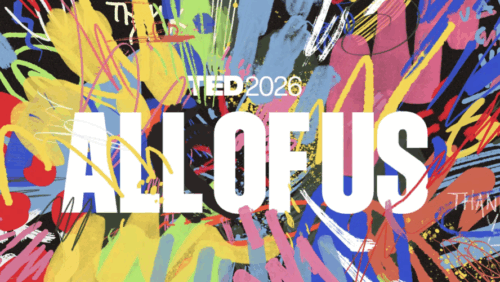
The theme “All of Us,” brought me back to a TEDx stage I had the privilege of speaking on 15 years ago – People 3.0: Leadership Beyond Barriers, alongside Dr. Mark Juretic, Blake Irving, and a lineup of thinkers I still draw from, thanks to my friend Jacqueline Lopez.
Different words. Same charge. Recalibrated for the operating environment C-suite leaders are actually in now.
Three ideas from this year’s stage crystallized what the executive authority gap actually looks like in 2026, and what closes it.
1. The “100-Year Response” Gap:
Why Silence Is Now a Liability
Former Commerce Secretary Gina Raimondo delivered one of the sharpest reframes of the week: “AI is a 100-year technology and needs a 100-year response.” She pointed to a reality most executives already sense but rarely name publicly: roughly 50 million workers are at risk of displacement, and no coordinated plan exists to absorb it.
The executive authority implication:
There was a recent era in which C-suite leaders could stay quiet on the AI workforce question. Let the comms team draft something if a reporter called. Keep internal messaging tight. Wait for the industry to settle.
That era is gone.
When 50 million workers are facing displacement and no one is holding the coordinated response, every CEO’s silence reads as a position.
The leaders who will hold this decade are the ones with a public point of view the market can hold them to. It doesn’t have to be safe or defensible but it must be specific. A stated operating philosophy on what their workforce becomes, what they’ll automate, what they won’t, and what they believe about the humans in their organization.
The absence of a defined position doesn’t read as neutrality anymore. It reads as drift. Markets, boards, and workforces are forming conclusions from the data they already have. Executive authority begins the moment you stop letting defaults speak for you.

2. The Exponential-Linear Gap
Why Specificity Is the New Act of Leadership
Van Jones named the math problem underneath everything we’re navigating: technology is on an exponential curve while human adaptation moves linearly. The widening gap, he argues, is the source of the social and economic instability we’re already feeling.
His call: a different kind of leadership… not one that moves faster, but one that brings people onto the curve.
The executive authority implication:
Every leader we work with has some version of the same instinct when the environment gets volatile: hedge the language, broaden the positioning, keep options open.
It is the exact wrong move.
In an exponential environment, generic leadership language leaves your people, your customers, and your market drifting. They can’t orient to you. They can’t decide whether to move with you. And because everyone else is hedging too, the specific voices cut through disproportionately.
Leaders can close that gap by being specific about what they stand for so others can move with them.
Specificity in a CEO’s public language isn’t a communications polish. It’s a coordinating function that aligns a large organization amid shifting conditions. Leaders’ executive branding help an organization of 5,000 or 50,000 people pulls in the same direction when everything is moving at different speeds.
The authority gap grows when leaders choose defensible over specific. Our Authority Brand Blueprints address this by pinpointing and clarifying the areas where vagueness harms the most.

3. The Prediction Gap
Why Your Brand Is Already Being Written by Systems You Didn’t Build
Philosopher Carissa Véliz gave the most quietly disruptive talk of the week. Her argument: the real threat to agency is prediction itself.
Algorithms are issuing verdicts about who people are – and who leaders are – before they’ve had a chance to prove otherwise.
For executives, this is the reality of 2026 brand-building stated plainly.
Your executive brand is already being written by systems you didn’t build.
- Search results
- AI chat summaries
- LinkedIn’s recommendation graph
- Media sentiment models
- Sell-side analyst language
- Earnings call transcripts indexed by the LLMs your investors are already using
All of it is assembling a version of you – a predicted you – that walks into the room before you do.
And because these systems optimize for the most confident synthesis of what’s already written, they default to the strongest signal or stereotype of a leader in your category unless your own language overrides it.
Definition is the defense.
The leaders who will hold ground over the next five years will be the ones who own their story: who they are, what category they lead, and what they refuse to be mistaken for. Specific enough that the systems synthesizing them are forced to use their words, not the default.
The Stakes on Executive Authority Have Changed
This is the work we do every day with CEOs, and the stakes have changed.
Eighteen months ago, an undefined executive brand cost you opportunity. Today, it costs you market leadership.
The systems shaping your market don’t wait. They write a version of you from whatever signal is loudest – one disgruntled employee, a market mishap, or your competitor’s story becomes what you’re being judged against.
Your board, your buyers, and your next hire meet that version first… unless you’re the one writing it.

Silence used to be prudent. Now it’s a liability.
– Wandia Chiuri CEO, Reactionpower
Why Demand Now Forms Around Authority

How to Close the Executive Authority Gap
The executive authority gap closes on three fronts, each one mapping to one of the TED 2026 ideas above:
- Take a public position. What is your operating philosophy on AI, workforce, and the next decade? If your market can’t name it, neither can you.
- Replace defensible language with specific language. Generic leadership copy is a coordinating failure. Specificity is how you pull your organization, your market, and your buyers onto the same curve.
- Define yourself faster than the systems define you. Search, AI summaries, and analyst models are writing a version of you right now. The only override is your own specific, repeatable, system-ready language.
This is the architecture of the Authority Brand Blueprint – the executive brand system we build for C-suite leaders who see this work as what it actually is: a growth lever, not a communications exercise.
Executive authority signals credibility in ways traditional campaigns cannot.
The Through-Line
Fifteen years ago, leadership beyond barriers meant leaders who could see past the constraints of their industry, geography, and era.
In 2026, the barriers have moved inside the systems we operate through – the algorithms, adaptation curves, and unwritten responses to technologies we’ve barely absorbed.
The charge on leaders hasn’t changed. The leaders who matter are the ones with a public point of view specific enough to hold in a fast-moving world, clear enough to bring others along, and defined enough that the systems writing about them have to use their language, not the default.
The barriers just keep evolving. And closing the executive authority gap is how leaders stay ahead of them.
Your executive authority is either compounding into enterprise growth or being converted into it by someone else.
Close the Executive Authority Gap Before Your Market Does It for You
At Reactionpower we design and scale executive brand systems for CEOs, CROs, CMOs, CTOs, and CPOs at Fortune 500 and high-growth companies who see executive authority for what it is: a balance-sheet asset. A growth lever.